
Connecticut Parole Release Authority
The Connecticut Board of Pardons and Paroles decides qualifying parole matters after a prison sentence. Its role becomes relevant when a Manchester defendant moved from Hartford Correctional Center into sentenced DOC custody and later sought conditional release. Parole does not erase the sentence. It permits a person to serve part of that sentence in the community under rules and supervision.
A Board record should be read with CT DOC and the criminal docket. BOPP can supply eligibility rules, hearing dates, special statutory hearing pages, and public proceedings. CT DOC shows the correctional status available on the live record. The court shows the sentence that created the custody term. Together, those sources distinguish parole from a sentence discharge, probation, facility transfer, or mere eligibility.
| Status | Authority | Meaning |
|---|---|---|
| Parole | BOPP and CT DOC | Conditional release from a prison sentence |
| Probation | Judicial Branch CSSD | Court-ordered community supervision |
| Discharge | CT DOC and sentence record | Correctional sentence ends |
| Eligibility | Statute and BOPP | The Board may consider release |
| Pardon | BOPP Pardon Division | A separate post-conviction process, not release from current custody |
Confirm Connecticut Parole Release
No single public BOPP name-search decisions database was confirmed in the research. Confirmation therefore uses the Board's hearing and event materials, the live DOC record, and the court case. A hearing date alone is not a grant. An eligibility date is not an order. The final status should come from the agency record.
- Search the CT DOC public inmate information and match the person by number, name, birth information, facility, and case facts.
- Review the BOPP hearing calendar or special hearing page for the relevant date and category.
- Read the docket or public Board material for an outcome such as granted, denied, continued, deferred, rescinded, revoked, or no action.
- Check the Manchester criminal case for the sentence and any special parole term imposed by the court.
- Contact BOPP or DOC when current supervision or release timing is not settled by public material.
A person can also move from confinement to parole after an approved date, yet another hold may block physical release. A warrant, detainer, pending case, or another authority can change the result. That is why the custody record and the Board decision must be read together.
Connecticut Parole Eligibility Records
C.G.S. § 54-125a governs ordinary parole eligibility. The research summarizes the usual split: qualifying nonviolent offenses may be considered after 50 percent of the sentence, while violent categories generally require 85 percent. Certain offenses are not eligible under ordinary parole rules. These thresholds identify when consideration may begin, not when release must occur.
BOPP states that physical-force offenses require service of at least 85 percent of the total effective sentence less jail credit. For qualifying offenses committed on or after July 1, 2013, risk reduction earned credits do not reduce that 85-percent parole eligibility date. C.G.S. § 18-98e still governs earned risk reduction credits, but their effect depends on the offense, date, sentence, and status.
- Eligibility date
- The first point at which the Board may consider a qualifying case.
- Grant
- A favorable Board action that may still carry a future date and conditions.
- Deferral
- A decision postponed for more information or a later review.
- Revocation
- Formal action ending parole after the required process.
Special rules apply to certain crimes committed by people under age 18 or under age 21. BOPP's Public Act 15-84 and Public Act 23-169 page explains those hearing paths. Use the official page and sentence record rather than applying a general percentage to a specific person.
Connecticut Parole Hearing Access
BOPP says parole and pardon hearings may be watched by video feed. Hearings begin at 9 a.m. unless posted otherwise and are held through virtual platforms. The special statutory page says people in custody appear by video from the institution listed on the Board docket, while public access uses the link posted on the BOPP homepage the morning of the hearing.
The special parole hearings page states that Public Act 15-84 hearings began in June 2016 and Public Act 23-169 hearings began in October 2024. It also links the relevant yearly calendar. Those dates help identify the hearing program, but final custody status still belongs to DOC and the official Board action.
BOPP warns that members of the public may not record a livestream except for the official recording prepared by the Board under C.G.S. § 1-226. Copies may be requested through the Board's FOI channel at BOPPFOI@ct.gov. A public recording request should include the person, hearing date, docket context, and the exact record requested.
Connecticut Parole Board Contact
Direct Board contact is appropriate for hearing access, parole resources, eligibility material, and public Board records. It is not a substitute for DOC when the question is current physical custody or a correctional discharge date.
55 West Main Street, Suite 520
Waterbury, CT 06702
203-805-6605
Parole and pardon authority
Give enough detail to route a request: full name, CT DOC number if known, hearing date or calendar category, and the exact public record. Do not ask the Board to infer a person's status from a name alone. Match any Board information against the live DOC record and the Manchester sentence.
The Manchester post-release supervision page explains how parole differs from court-run probation. That distinction matters because the Board cannot confirm a probation term, and Adult Probation does not decide a prison parole grant.
Manchester Parole Release Records
A Manchester case can begin with police, pass through G.A. 12, move to Hartford Correctional Center, and later reach another DOC prison. The Board enters the path only when a qualifying prison sentence and parole process exist. A short police release, bond release, dismissal, or probation-only sentence does not become a BOPP parole case.
The best evidence set includes the court sentence, DOC identity and status, BOPP hearing material, and a release or supervision record from the responsible agency. If the DOC search no longer displays the person, contact DOC Public Information and use the court docket. VINE may have delivered a custody-change alert, but it is not a permanent decisions archive.
A pardon is also separate. BOPP publishes pardon eligibility information, yet pardon eligibility does not show that someone was released from custody. Keep the requested record tied to the actual question: parole hearing, parole grant, current supervision, discharge, or pardon.
Note: The Board explains parole authority; CT DOC and the court establish the underlying custody and sentence.
View Connecticut Parole Source
The official BOPP eligibility resource shows the state authority's public post-conviction channel.
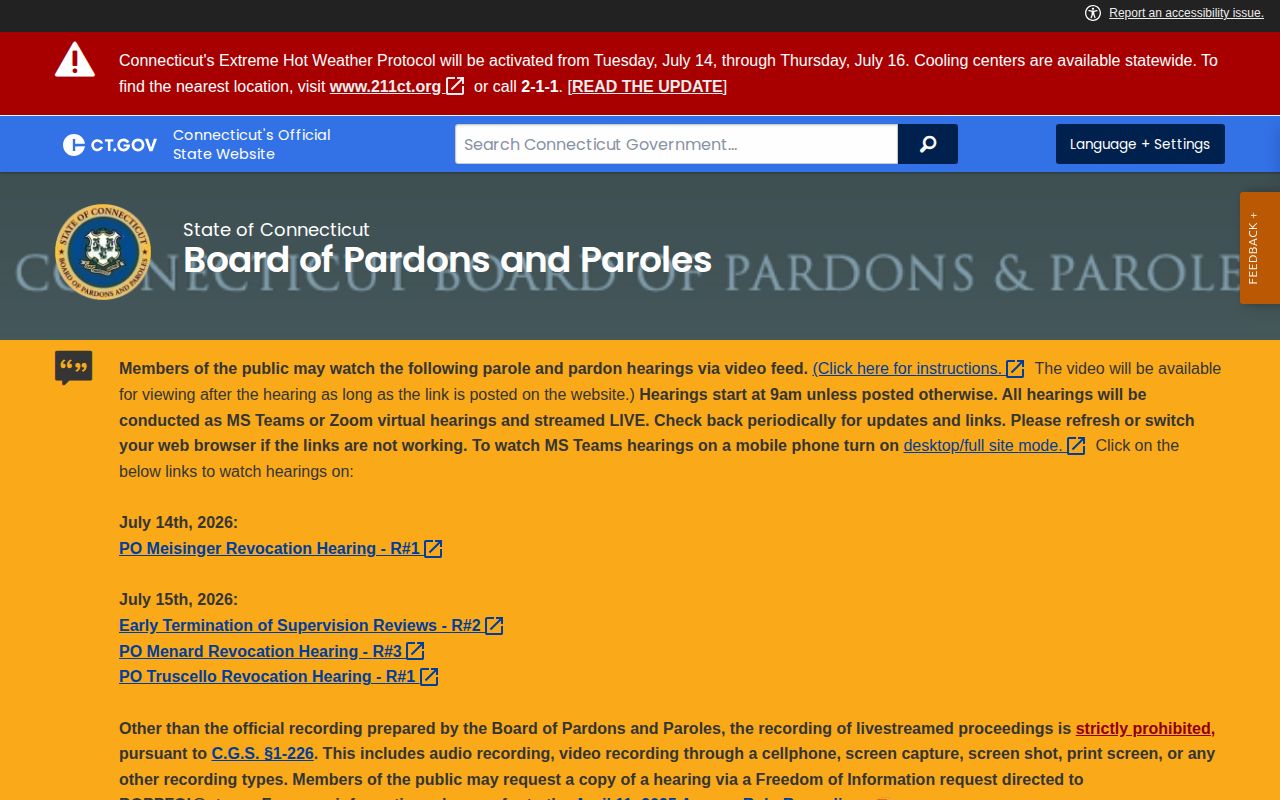
The agency page should be used with DOC and court records because eligibility information alone does not confirm a release.
BOPP separates pardon eligibility from parole release authority. A pardon application concerns post-conviction relief, while a parole record concerns conditional release from an active sentence. The correct label prevents the image or agency page from being read as proof of current custody status.
The Board hearing calendar identifies scheduled review, while the special statutory page identifies the hearing category. Neither replaces the final action. Request the official recording through the stated FOI channel when a public hearing record is needed, then compare the outcome with current DOC status and the Manchester sentence.
BOPP states that public parole and pardon hearings usually start at 9 a.m. unless the posted notice says otherwise. Hearings are conducted through MS Teams or Zoom and streamed live. For the Public Act 15-84 and Public Act 23-169 categories, the Board says the video link appears on its homepage the morning of the hearing, while the person in custody appears by video from the correctional facility named on the docket.
A hearing result must be described with the Board wording. Possible actions include granted, denied, continued, deferred, no action, rescinded, or revoked. The research did not confirm one public name-search database containing all decisions. Use the event calendar, the special hearing pages, the FOI recording request channel, CT DOC status, and the Manchester court sentence instead of inventing a results portal.